
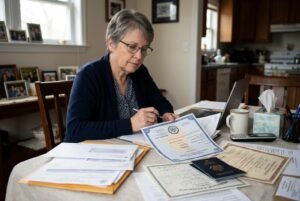
Losing a life partner is overwhelming under any circumstances, and navigating the aftermath while living or traveling outside the United States adds an extra layer of stress. Because a foreign funeral home cannot automatically report the death to the Social Security Administration (SSA) the way a U.S. funeral director would, you will need to handle two important tracks yourself: getting official U.S.-recognized proof of death and claiming your Social Security survivor benefits.
Taking these steps one at a time will help protect your finances and ensure your benefits continue smoothly without interruption.
1. Obtain the “Consular Report of Death Abroad” (CRDA)
A local foreign death certificate on its own is usually not accepted by the SSA, U.S. banks, or probate courts. You will need an official U.S. document to verify the passing.
-
Contact the U.S. Embassy or Consulate: You (or a family representative) must report the death to the nearest U.S. Embassy or Consulate in the country where your spouse passed away.
-
Request the CRDA: Once you provide the local foreign death certificate, your spouse’s U.S. passport, and their Social Security number, the embassy will issue a Consular Report of Death of a U.S. Citizen Abroad (CRDA). This serves as the official U.S.-recognized death certificate. Many embassies now issue an electronic CRDA that you can print and use immediately, though ordering several certified physical copies for banks and insurance companies is always wise.
-
If your spouse was not a U.S. citizen: If your spouse was a green card holder or non-citizen collecting Social Security, the U.S. embassy cannot issue a CRDA. Instead, request multiple original certified copies of the foreign death certificate along with an Apostille (international authentication) and a certified English translation.
2. Report the Death to Social Security Immediately
Do not wait for the final paperwork to arrive in the mail before notifying the SSA by phone, especially if your spouse was already receiving monthly benefits. Please note that a death cannot be reported online.
-
If you have returned to the U.S.: Call the SSA directly at 1-800-772-1213 (Monday through Friday, 8:00 AM to 7:00 PM) or contact your local SSA field office to report the date of death and schedule an appointment for your Social Security survivor benefits.
-
If you are still abroad: Contact the Federal Benefits Unit (FBU) at the U.S. Embassy in that country, or call the SSA Office of International Operations at 1-855-522-6936.
3. Protect Your Bank Account (The “Month of Death” Rule)
One of the most important financial tips for surviving spouses is not to spend the final check or close the bank account where your spouse’s Social Security payments were deposited right away:
-
How the schedule works: Social Security pays benefits one month behind. For example, the deposit that arrives in November is actually the payment for October.
-
The Month of Death Rule: By law, no benefits are payable for the month in which a beneficiary passes away. Even if your spouse passed away on October 31, the payment that arrives in November must be returned.
-
Preventing overdrafts: If your spouse received payments via direct deposit, the SSA will automatically reclaim (debit) any overpaid month directly from the bank account once the death is reported. Leaving those funds untouched in the account prevents unexpected overdraft fees or collection notices.
4. How to Claim Social Security Survivor Benefits & the Lump-Sum Payment
When you speak to the SSA representative to report the passing, ask to schedule an appointment to apply for your Social Security survivor benefits:
-
Monthly Survivor Benefits: If you are at least age 60 (or age 50 if living with a disability), you may be eligible to switch to your spouse’s benefit amount if their monthly payment was higher than yours.
-
One-Time Lump-Sum Death Payment: A surviving spouse who was living with the deceased (or is eligible for benefits on their record) can also claim a one-time lump-sum payment of $255.
-
Documents you will need for your appointment:
-
The Consular Report of Death Abroad (CRDA) or certified foreign death certificate with Apostille
-
Both of your Social Security numbers
-
An original or certified copy of your Marriage Certificate
-
Proof of your U.S. citizenship or lawful residency
-
Your bank routing and account numbers for direct deposit
-
Moving Forward at Your Own Pace
Dealing with international paperwork while grieving is never easy. Focus first on notifying the U.S. Embassy and calling Social Security to pause overpayments—once that initial phone call is made, you will have plenty of time to gather your documents for your survivor benefit appointment.