
Roth IRA Contribution Limits
| Tax Year | Max Contribution (Under Age 50) | Max Contribution (Age 50+) | Single MAGI Phase-Out Range | Married Filing Jointly MAGI Phase-Out |
| 2025 | $7,000 | $8,000 | $150,000 – $165,000 | $236,000 – $246,000 |
| 2026 | $7,500 | $8,600 | $153,000 – $168,000 | $242,000 – $252,000 |
Tax-Free Withdrawal Rules
-
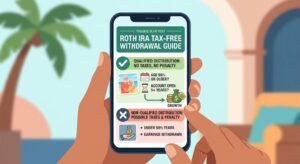
Contributions First: The IRS dictates that withdrawals always come from your original contributions first. Because these were made with after-tax dollars, you can withdraw them at any time, at any age, completely tax-free and penalty-free.
-
Qualified Earnings Withdrawals: To withdraw your investment earnings tax-free and penalty-free, you must meet a two-part test: the account must have been open for at least five tax years, and you must be at least 59 ½ years old.
-
The 5-Year Rule for Contributions: The five-year clock begins on January 1 of the tax year for which you made your first Roth IRA contribution, regardless of what month the deposit actually occurred.
-
The 5-Year Rule for Conversions: Every time you convert funds from a Traditional IRA to a Roth IRA, a separate five-year waiting period begins for that specific conversion amount. Withdrawing converted funds before this period ends while under age 59 ½ triggers a 10% penalty.
-
Exceptions to the Penalty: If you are under 59 ½ and have not met the five-year rule, you will owe taxes on withdrawn earnings, plus a 10% penalty. However, the IRS waives the 10% penalty for specific circumstances, including a first-time home purchase (up to a $10,000 lifetime limit), permanent disability, or qualified higher education expenses.
-
Earned Income is Mandatory: You or your spouse must have taxable earned income (compensation) for the year you make the contribution.
-
Eligible Income Sources: Earned income includes wages, salaries, tips, bonuses, and net earnings from self-employment or part-time consulting.
-
Ineligible Income Sources: Passive income sources—such as Social Security benefits, pension payouts, traditional IRA or 401(k) distributions, dividends, interest, and capital gains—do not count as earned income.
-
Spousal Contributions: If you do not have earned income but are married and file taxes jointly, you can still contribute to your own Roth IRA based on your working spouse’s earned income.
-
No Age Limits: There is no maximum age limit for contributing to a Roth IRA; you can contribute at any age as long as you have qualifying income.
In most cases, rental income does not count toward your Roth IRA contribution limit because the IRS considers it passive (unearned) income. However, short-term rentals have a specific exception based on how you operate the property.
Here is how the IRS views short-term rental income for IRA purposes:
-
Standard Short-Term Rentals (Passive): If you simply rent out a property on platforms like Airbnb or VRBO and only provide basic amenities (like utilities, trash collection, and cleaning between guests), the income is treated as passive. It is reported on Schedule E of your tax return, is not subject to payroll taxes, and cannot be used to fund a Roth IRA.
-
Providing “Substantial Services” (Active): If you operate the short-term rental more like a hotel or bed-and-breakfast, the IRS may classify it as an active business. This requires providing “substantial services” for your guests while they are staying there, such as daily maid service, cooking meals, transportation, or concierge services.
-
The Schedule C Requirement: If you provide these substantial services, your rental income is reported on Schedule C (Profit or Loss from Business) rather than Schedule E.
-
Self-Employment Tax & IRA Eligibility: Because Schedule C income is treated as active business income, it is subject to self-employment taxes (Medicare and Social Security). Consequently, this income does count as earned income, allowing you to use it to contribute to your Roth IRA.
If you believe your short-term rental operations qualify as providing substantial services, you should consult a tax professional to ensure you are filing the correct schedules and paying the required self-employment taxes before making IRA contributions.
Here is how the IRS treats 1099 translation income for retirement contributions:
-
Self-Employment Earnings: As an independent contractor, your freelance translation income is typically reported on Form 1099-NEC (Nonemployee Compensation). Because this is considered active self-employment income—and is subject to self-employment taxes on Schedule C of your tax return—it fully qualifies as earned income for IRA purposes.
-
The Net Income Rule: Your maximum Roth IRA contribution is based on your net earnings from self-employment, not your gross 1099 total. You must first take your total translation income and subtract any deductible business expenses (like translation software, home office deductions, or internet costs), as well as the deductible portion of your self-employment tax.
-
Contribution Caps: As long as your net translation earnings equal or exceed the amount you want to deposit, you can contribute up to the annual IRS maximum ($7,500 for 2026, or $8,600 if you are 50 or older). If your net earnings are lower than the maximum, you can only contribute up to the exact amount you earned.
-
Alternative Accounts: Because you are a 1099 earner, you are essentially a small business owner. If your translation income grows significantly, you are also eligible to open specialized self-employed retirement accounts—like a SEP IRA or a Solo 401(k). These plans offer much higher contribution limits (up to $72,000 for 2026) and can sometimes include Roth options.